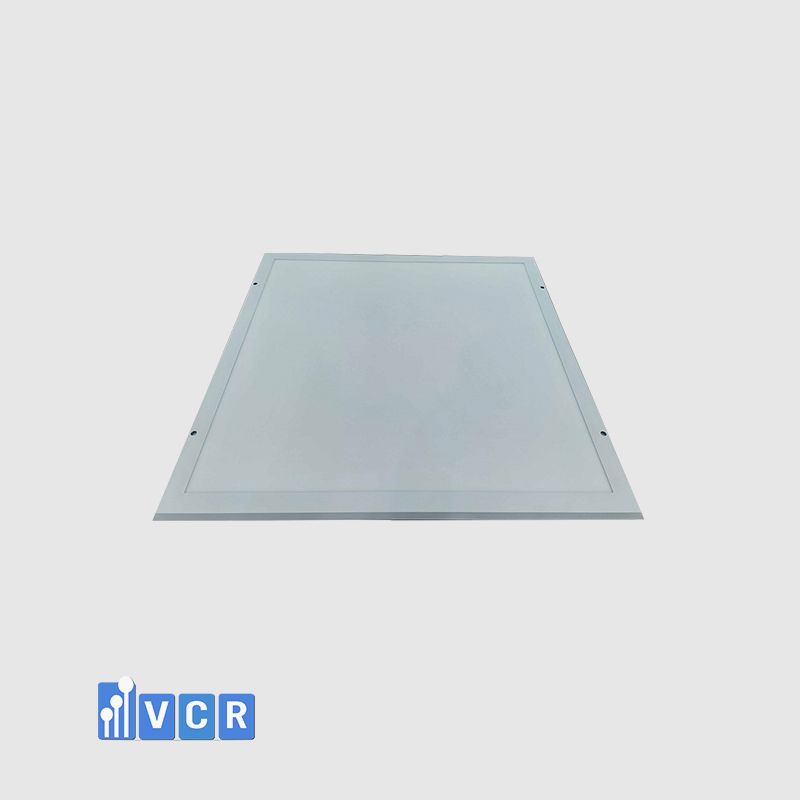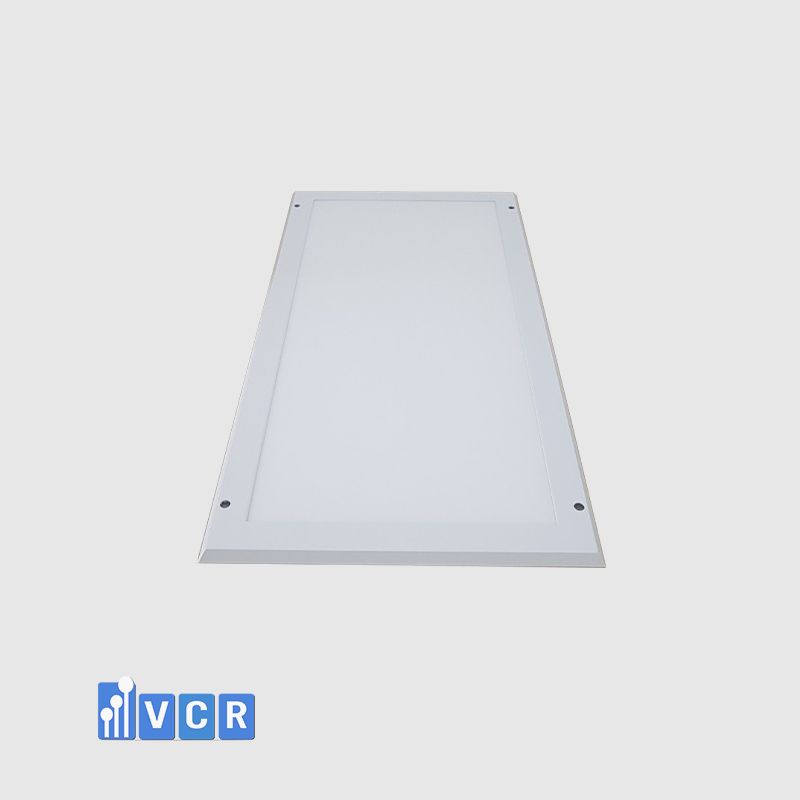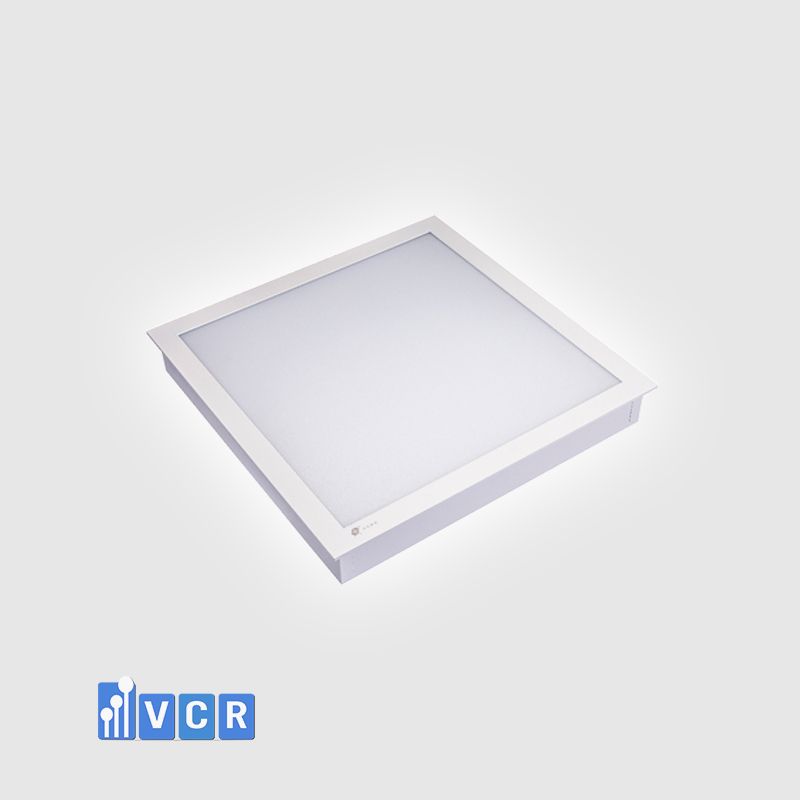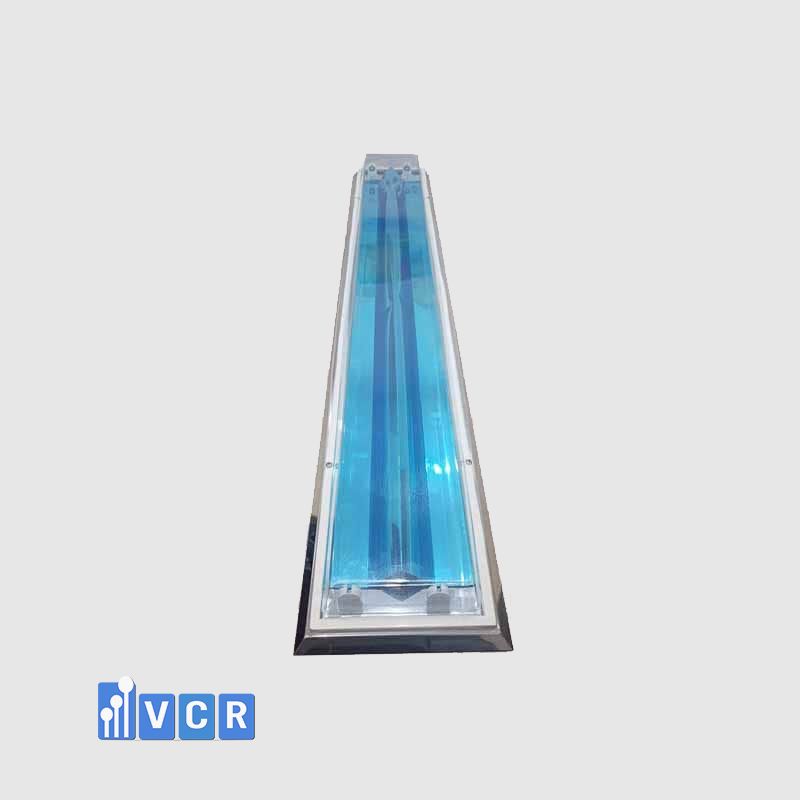

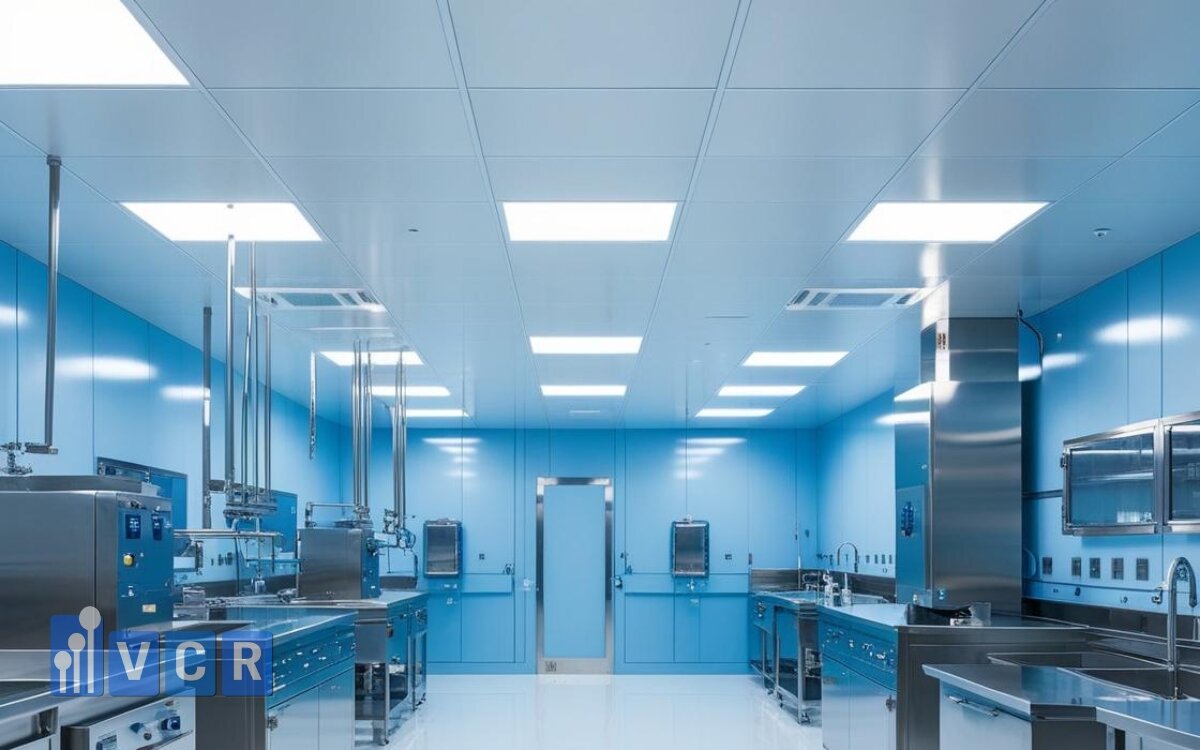
Buying reliable cleanroom lights in Hanoi requires evaluation of sealing, dust and moisture protection, illuminance, glare, colour rendering, housing materials, LED drivers, installation method, technical documentation, and compatibility with the cleanroom ceiling system.
- What Is a Cleanroom Light?
- Why Do Facilities in Hanoi Need Specialised Cleanroom Lighting?
- How Is a Cleanroom Light Different from a Standard LED Panel?
- Must Every Cleanroom Light Be IP65?
- Common Cleanroom Light Types
- Recessed Cleanroom Lights
- Surface-Mounted Cleanroom Lights
- Cleanroom LED Panel Lights
- Explosion-Proof Cleanroom Lights
- What Does “Genuine” Mean for a Cleanroom Light?
- Why Price Alone Is Not Enough
- Criteria for Selecting a Reliable Cleanroom Light Supplier in Hanoi
- Understanding the Ceiling System
- Correct Illuminance
- Luminous Flux and Power
- Colour Rendering Index
- Consistent Colour Temperature
- Glare and Light Diffusion
- Suitable IP Rating
- Housing and Diffuser Materials
- Traceable LED Chips and Drivers
- Thermal Management
- Maintenance and Replacement
- Technical Documentation
- What Power Rating Should Be Selected?
- Should Cleanroom Lighting Use Neutral White or Cool White?
- How to Inspect Cleanroom Lights During Delivery
- Transportation and Installation in Hanoi
- Common Purchasing Mistakes
- Where to Buy Reliable Cleanroom Lights in Hanoi
- Why Choose a Supplier with Integrated Capability?
- Information Required for a Quotation
- Frequently Asked Questions
- Conclusion
What Is a Cleanroom Light?
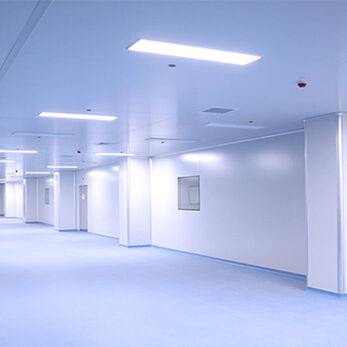
A cleanroom light is a lighting fixture designed for controlled environments where dust, microorganisms, pressure, humidity, surface cleanability, and contamination risks must be managed.
Unlike standard commercial lighting, a cleanroom lighting fixture should minimise gaps, dust accumulation, particle release, and air leakage through the ceiling installation.
Cleanroom lights may be recessed, surface mounted, panel mounted, or integrated into a modular cleanroom ceiling.
They are widely used in pharmaceutical, food, dietary supplement, cosmetic, electronics, semiconductor, medical-device, healthcare, operating-room, laboratory, and research facilities.
Why Do Facilities in Hanoi Need Specialised Cleanroom Lighting?
Hanoi contains industrial parks, hospitals, research centres, pharmaceutical plants, food factories, cosmetic facilities, electronics manufacturers, and medical-device operations.
These facilities often use panel ceilings, sealed ceilings, or technical ceiling systems that must maintain cleanliness and pressure control.
A standard office light may leave gaps around the installation frame, collect dust, and create surfaces that are difficult to clean.
Unsuitable lighting materials may also deteriorate when exposed to cleaning chemicals or humid conditions.
In production areas, poor lighting uniformity or low colour rendering can affect surface inspection, label reading, colour recognition, and technical operations.
A suitable cleanroom light supports ceiling integrity, cleanable surfaces, stable illumination, and reliable visual conditions.
How Is a Cleanroom Light Different from a Standard LED Panel?
A standard LED panel is primarily designed for offices, shops, and general commercial buildings.
A cleanroom light must also address sealing, dust protection, moisture protection, cleanability, and ceiling compatibility.
Some office panels have similar external dimensions, but their frames, diffusers, wiring entries, and driver compartments may not provide suitable sealing.
Air may pass through gaps around the fixture or through the internal housing.
Cleanroom lights normally use flatter, sealed surfaces with hygienic detailing and reduced dust-retention points.
The buyer should not assume that every 600 × 600 mm LED panel is suitable for a cleanroom.
Must Every Cleanroom Light Be IP65?
Not every project requires IP65, but the ingress-protection level must suit the actual environment.
The IP rating indicates protection against solids and water under defined conditions.
Dry areas without wet cleaning may permit a lower protection level.
Areas with frequent cleaning, high humidity, water spray, or stricter dust control may require IP65 or another appropriate rating.
However, the fixture IP rating alone does not guarantee that the complete ceiling installation is sealed.
The gasket, mounting frame, fasteners, and interface between the light and ceiling panel must also be correctly designed.
Common Cleanroom Light Types
Recessed Cleanroom Lights
A recessed fixture is installed so that the light face is nearly flush with the ceiling surface.
This reduces dust-retention points and creates a surface that is easier to clean.
Recessed lights are commonly used with cleanroom panel ceilings or ceiling systems with predesigned openings.
The fixture and ceiling-opening dimensions must be confirmed before ceiling production.
Surface-Mounted Cleanroom Lights
A surface-mounted fixture is installed below the ceiling.
This approach is suitable where recessed installation is not possible or where lighting is added after construction.
The design should minimise exposed gaps and dust-retention edges.
The housing should be smooth, sealed, and easy to clean.
Cleanroom LED Panel Lights
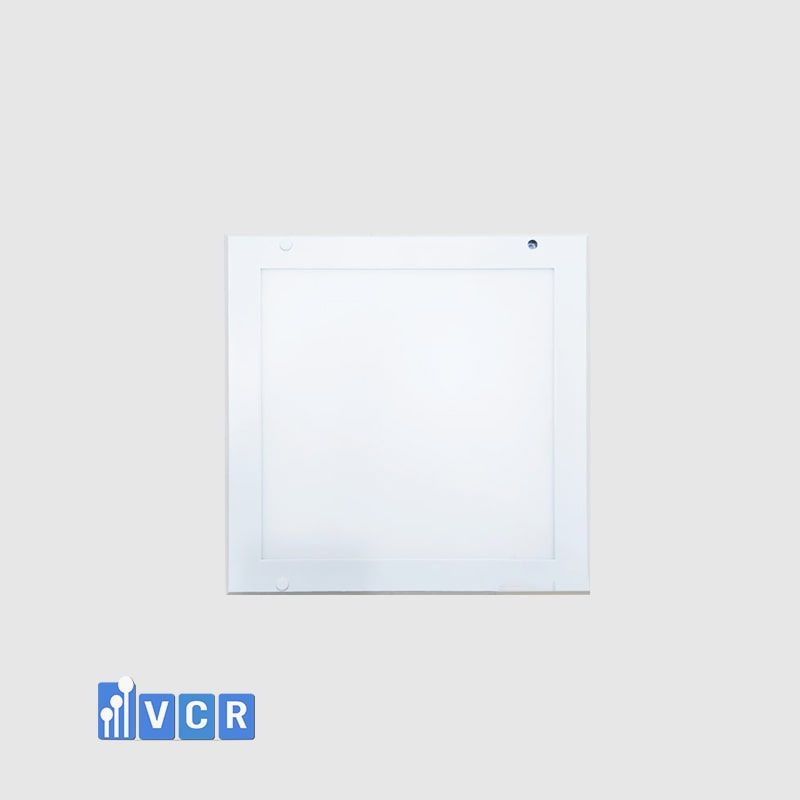
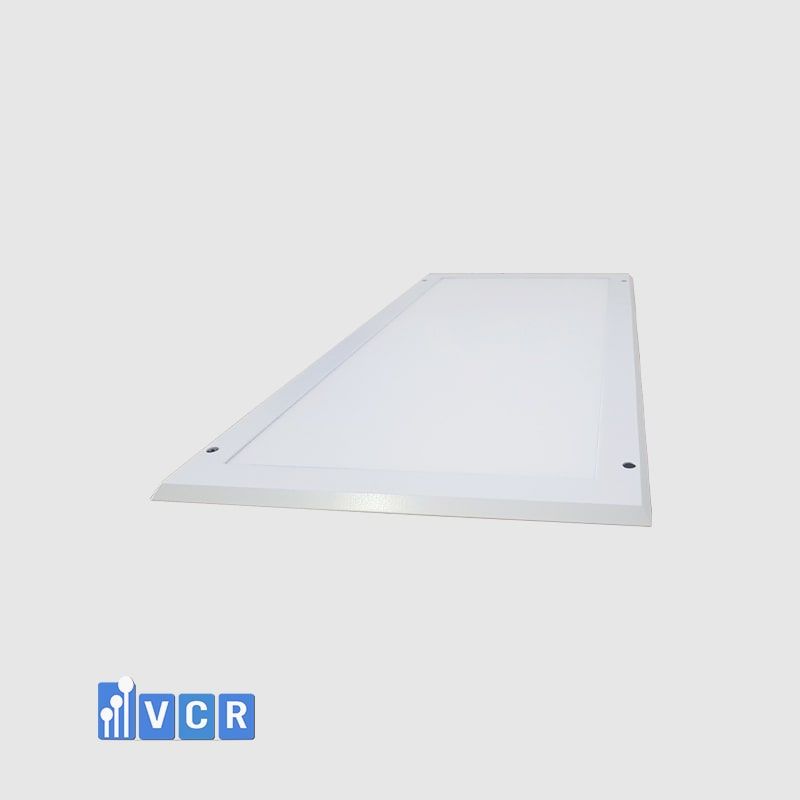
Panel lights are commonly square or rectangular and use LED sources with a light-diffusing cover.
Typical sizes may include 300 × 300 mm, 300 × 600 mm, 300 × 1200 mm, and 600 × 600 mm, as well as custom dimensions.
They suit modular ceilings and can provide relatively uniform illumination.
Explosion-Proof Cleanroom Lights
Areas containing solvents, flammable gases, or hazardous atmospheres may require certified explosion-proof lighting.
A sealed cleanroom light is not automatically explosion proof.
The two requirements should not be treated as equivalent.
What Does “Genuine” Mean for a Cleanroom Light?
A genuine product should have a clearly identified manufacturer, model, technical specification, traceable components, and documentation matching the delivered fixture.
The quotation should identify:
-
Power.
-
Voltage.
-
Dimensions.
-
Luminous flux.
-
Luminous efficacy.
-
Colour temperature.
-
Colour rendering index.
-
IP rating.
-
Housing material.
-
Diffuser material.
-
LED-chip specification.
-
LED driver.
-
Design life.
-
Warranty.
-
Installation method.
A logo or product label alone is not sufficient evidence that the complete fixture and internal components are traceable.
The LED chips, driver, housing, and thermal design all affect service life and long-term lighting stability.
Why Price Alone Is Not Enough
Two fixtures with the same power and dimensions may differ significantly in luminous flux, glare, colour rendering, LED quality, driver quality, and housing construction.
A low-cost fixture may lose brightness rapidly, flicker, overheat, or shift colour after a short period.
A low-quality diffuser may yellow, crack, or lose light transmission.
An unstable driver may produce flicker that is difficult to see directly but can still affect operator comfort.
If the fixture is not properly sealed, dust and moisture may enter the housing and reduce service life.
Buyers should compare lifecycle cost, including purchase price, electricity use, replacement frequency, maintenance, and production disruption.
Criteria for Selecting a Reliable Cleanroom Light Supplier in Hanoi
Understanding the Ceiling System
The supplier should identify whether the project uses panel ceilings, T-bar ceilings, sealed ceilings, technical ceilings, or walkable ceilings.
Each system requires a different installation method.
If fixture dimensions do not match the ceiling module, installation may create gaps, require site modification, or reduce finish quality.
For panel ceilings, the supplier should confirm panel thickness, opening dimensions, suspension method, and sealing arrangement.
Correct Illuminance
Illuminance should match the actual task.
Corridors, warehouses, changing rooms, production rooms, visual-inspection areas, and laboratories may require different light levels.
Fixture quantity should not be determined only from floor area.
Ceiling height, surface reflectance, equipment, obstructions, and task requirements must also be considered.
A suitable design should evaluate average illuminance, uniformity, and glare control.
Luminous Flux and Power
Electrical power does not fully describe the amount of light produced.
Two 40 W fixtures may provide very different luminous flux.
The buyer should consider luminous efficacy, which indicates how much light is produced per watt.
Higher efficacy reduces electricity use and heat generation.
This is important because lighting heat contributes to the cleanroom HVAC load.
Colour Rendering Index
The colour rendering index indicates how accurately colours appear under the light source.
Suitable colour rendering supports label reading, status recognition, surface inspection, and process work.
Colour-sensitive inspection or laboratory tasks may require a higher value.
The supplier should recommend the CRI according to the actual task rather than applying one value to every room.
Consistent Colour Temperature
Colour temperature should be selected according to visual requirements and the facility’s internal standard.
Neutral white and cool white lighting are commonly used in production environments.
If fixtures in the same room use different colour temperatures, the room may appear inconsistent.
The supplier should control colour specification and production-batch consistency.
Glare and Light Diffusion
High luminous flux with poor diffusion may create glare.
Glare can increase eye fatigue, reduce screen visibility, and make long-duration work uncomfortable.
The diffuser should distribute light evenly and reduce direct visibility of bright LED points.
Lighting layout should consider worktables, machinery, monitors, and reflective metal surfaces.
Suitable IP Rating
The supplier should state the IP rating of the complete fixture.
The rating should not apply only to one component.
It must match dust, humidity, cleaning, and washdown conditions.
The ceiling interface must also be sealed appropriately.
Housing and Diffuser Materials
The housing may be manufactured from powder-coated steel, aluminium, or stainless steel.
Powder-coated steel suits many general applications where the finish remains stable and cleanable.
Aluminium is lightweight and supports heat dissipation.
Stainless steel may be selected for corrosive environments, frequent cleaning, or higher material requirements.
The diffuser may use polycarbonate, PMMA, or another suitable material.
It should resist yellowing, cracking, and deformation.
Traceable LED Chips and Drivers
The LED chips influence efficacy, colour stability, and lumen maintenance.
The driver affects flicker, service life, and protection against voltage variation.
The supplier should identify the brand or technical specification of the chips and driver.
A general statement such as “premium LED” is not sufficient.
Thermal Management
High temperature reduces LED-chip and driver life.
The fixture housing should support heat dissipation while maintaining sealing.
An excessively thin housing or poorly positioned driver may trap heat.
The design should support long operating hours in industrial facilities.
Maintenance and Replacement
The fixture should allow driver or LED-module replacement without unnecessary ceiling damage.
Maintenance access must match cleanroom requirements and avoid uncontrolled dust release.
Where access above the ceiling is limited, maintenance from below may be required.
Standardising fixture models simplifies spare-parts management.
Technical Documentation
The supplier should provide a technical datasheet, dimensional drawing, wiring diagram, and installation instructions.
Depending on the project, the buyer may request quality certificates, factory records, test reports, material documentation, or electrical-safety information.
Product labels should match the quotation and delivery records.
For large projects, item codes and batch identification support quality control.
What Power Rating Should Be Selected?
Power should not be selected from room area alone.
The correct value depends on luminous flux, ceiling height, fixture spacing, surface reflectance, and required illuminance.
Fixtures rated at 36 W, 40 W, or 48 W may suit different applications depending on efficacy.
A proper lighting calculation is more reliable than selecting power by simple experience.
Should Cleanroom Lighting Use Neutral White or Cool White?
Neutral white can provide a comfortable appearance and more natural colour perception.
Cool white may create a brighter visual impression and is commonly used in production areas.
The best option depends on the task, internal standards, and colour-recognition requirements.
Consistency across the room is particularly important.
How to Inspect Cleanroom Lights During Delivery
The buyer should check the model, power, dimensions, quantity, and IP rating.
The housing should be free from dents, bending, scratches, and coating damage.
The diffuser should be flat and free from cracks, discolouration, or deformation.
Gaskets should be continuous and firmly attached.
Wiring, connectors, and drivers should be securely installed.
A sample operating test should check abnormal flicker, noise, colour variation, and lighting stability before full installation.
Transportation and Installation in Hanoi
Fixtures should be packed to prevent impact, moisture, dust, and frame deformation.
Diffusers should be protected against scratching.
Heavy objects should not be placed on the cartons.
Before installation, the ceiling opening, electrical supply, ceiling level, and cable route should be checked.
After installation, the interface between the fixture and ceiling should be sealed according to the approved design.
For operating facilities, replacement work should control dust, falling objects, electrical safety, and production downtime.
Common Purchasing Mistakes
A common mistake is purchasing office lighting that looks similar to a cleanroom fixture.
Another mistake is comparing only power while ignoring luminous flux and efficacy.
Some projects fail to confirm ceiling-opening dimensions before ordering, causing panel modification at the site.
Others request a high IP rating without checking the sealing method between the fixture and ceiling.
Low colour rendering or excessive glare can affect inspection and operator comfort.
Using many different fixture and driver models also complicates maintenance and spare-parts control.
Where to Buy Reliable Cleanroom Lights in Hanoi
Buyers should select a supplier that understands lighting, cleanroom panel ceilings, electrical installation, and contamination-control requirements.
The supplier should be able to recommend dimensions, power, luminous flux, colour temperature, colour rendering, IP rating, materials, and installation method.
Vietnam Cleanroom Equipment, also known as VCR Cleanroom, supplies cleanroom equipment to cleanroom contractors, pharmaceutical plants, food manufacturers, dietary supplement facilities, cosmetic factories, electronics and semiconductor facilities, medical-device operations, hospitals, and laboratories.
VCR can support cleanroom-light selection according to ceiling type, ceiling module, required illuminance, cleaning conditions, and project specifications.
For projects in Hanoi, a site survey or ceiling-drawing review can reduce the risk of incorrect dimensions, unsuitable installation, and poor sealing.
Where traceability is required, the quotation should identify the manufacturer, model, LED chips, driver, power, luminous flux, IP rating, and warranty.
Why Choose a Supplier with Integrated Capability?
Cleanroom lights interact directly with panel ceilings, suspension structures, electrical systems, HVAC, and cleaning requirements.
A supplier that only sells fixtures without understanding the ceiling system may create installation and sealing problems.
An integrated supplier can coordinate drawings, model selection, ceiling openings, delivery, installation, and illuminance verification.
Standardising several fixture models across the facility can reduce spare-parts inventory and simplify maintenance.
After-sales service should support driver replacement, LED-module replacement, flicker troubleshooting, and spare-parts supply.
Information Required for a Quotation
The buyer should provide the ceiling type, opening dimensions, room height, and area.
Required illuminance, expected power, colour temperature, colour rendering, and IP rating should be stated.
The installation method, housing material, electrical supply, and control requirements should also be defined.
For replacement projects, photographs of the existing fixture, label, dimensions, and installation position are helpful.
For new projects, the reflected ceiling plan allows more accurate fixture quantity and layout design.
Frequently Asked Questions
What is “Đèn phòng sạch” in English?
Common terms include cleanroom light, cleanroom LED light, and cleanroom lighting fixture.
Must every cleanroom light be IP65?
No. The required IP rating depends on dust, humidity, cleaning, and project conditions.
Can a standard office LED panel be used in a cleanroom?
It should not be assumed suitable. Office panels may not meet sealing, material, cleanability, and installation requirements.
Can cleanroom lights be custom manufactured?
Yes. Fixtures may be produced for custom ceiling dimensions, recessed mounting, surface mounting, or special project requirements.
What colour temperature should be used?
The selection depends on the task and facility standards. Consistency and suitability for visual work are more important than using one universal value.
Does higher wattage always mean more light?
No. Luminous flux and efficacy also determine brightness. Two fixtures with the same wattage may produce different light output.
What should be checked during delivery?
Check the model, dimensions, power, IP rating, housing, diffuser, gasket, driver, colour appearance, and packaging condition.
What affects cleanroom-light service life?
Service life depends on LED-chip quality, driver quality, operating temperature, thermal management, voltage stability, and operating hours.
Conclusion
Buying reliable cleanroom lights in Hanoi requires evaluation of sealing, IP rating, power, luminous flux, efficacy, colour rendering, colour temperature, glare, housing materials, LED chips, drivers, and installation method.
A suitable fixture should do more than provide enough light. It must integrate with the ceiling, remain easy to clean, operate reliably, and minimise impact on the controlled environment.
Vietnam Cleanroom Equipment can work with facility owners and cleanroom contractors to select, supply, install, and standardise cleanroom lights for projects in Hanoi and northern Vietnam.